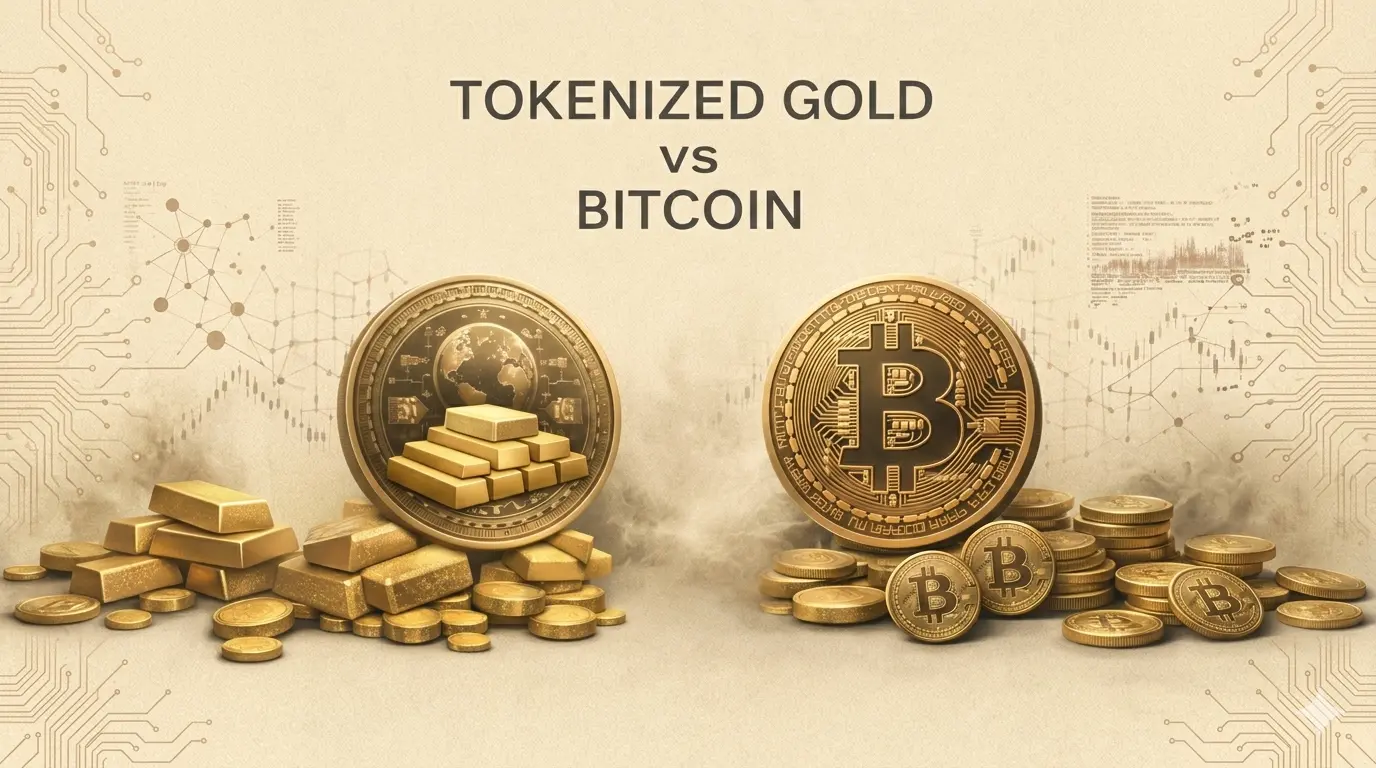
The Sovereign and the Synthetic: Gold vs Bitcoin and the Future of Monetary Standards
Mon Feb 23 2026
The Sovereign and the Synthetic: A Deep Dive into Gold, Bitcoin, and the Future of Monetary Standards
In a world where confidence in traditional fiat currencies is eroding, two rivals dominate the conversation about the future of money: Gold and Bitcoin.
One has anchored economies for millennia; the other is barely over a decade old yet has challenged the very notion of what constitutes monetary value.
This analysis explores the ideological, technological, and philosophical divide between these two monetary systems - and how concepts like tokenized gold are bridging the gap between legacy wealth and digital sovereignty.
I. The Foundations of Value: Intrinsic vs. Subjective
Where does value originate?
Gold’s intrinsic value emerges from its physical attributes: rarity, durability, and industrial utility in sectors from jewelry to electronics. Traditional economists argue that money historically evolved from barter, selecting gold precisely because it already held measurable market value.
By contrast, Bitcoin’s value arises not from physical use but from shared belief in its mathematical scarcity and network consensus. Grounded in Austrian economic theory, the digital camp asserts that all value is subjective - determined by human preference rather than material composition.
From this perspective, Bitcoin is not “tokenized nothing,” but an innovation that embodies pure monetary consensus - a global system of trust secured by cryptography rather than institutions.
II. Scarcity Over Time: Gold’s Stability vs. Bitcoin’s Algorithmic Discipline
Longevity as a store of value depends on an asset’s resistance to supply inflation.
Gold expands in supply by approximately 2% annually, mirroring global population growth over centuries. This consistency supports price stability but remains susceptible to increased production when prices surge - an elastic response that can dilute scarcity.
Bitcoin, on the other hand, is defined by absolute supply inelasticity. Its issuance is capped at 21 million units, and periodic “halving events” reduce the mining reward every four years. Combined with an automatic difficulty adjustment, this protocol ensures predictable scarcity unaffected by human discretion.
Currently, Bitcoin’s estimated annual issuance ($12 billion) is dwarfed by new gold mining ($700 billion) - a disparity that strengthens Bitcoin’s “Stock-to-Flow ratio” and appeals to those seeking mathematically enforced scarcity.
III. Portability and Custody: Physical Weight vs. Digital Self-Sovereignty
Money must move effortlessly through both time and space. While gold triumphs across generations, its physical nature limits transport and settlement efficiency.
To address this, innovators introduced tokenized gold - digital tokens backed by real gold reserves stored in secure vaults (e.g., Tether Gold or PAX Gold). This fusion of physical backing and digital transferability offers “the best of both worlds”: the trust of tangible metal with the frictionless speed of blockchain transactions.
However, Bitcoin maximalists contend that tokenized gold reintroduces custodial risks - reliance on centralized entities for audits, storage, and redemption. History provides cautionary lessons: gold confiscations, regulatory seizures, and banking restrictions have repeatedly undermined physical wealth.
Bitcoin circumvents these vulnerabilities through self-custody secured by private keys, providing what some describe as “unseizable property” - a form of digital autonomy unmatched by any physical asset.
IV. Market Behavior and Adoption Cycles
Gold remains the archetype of wealth preservation, compounding at roughly 8-9% annually over the past half-century. It serves primarily as an inflation hedge and foundation for central bank reserves.
Bitcoin, conversely, has displayed explosive volatility - viewed by critics as speculation, yet by supporters as a process of global price discovery. Its volatility reflects a young asset class absorbing capital from legacy systems and maturing toward stability.
Gold’s dominant market capitalization (≈ $14 trillion) underscores its maturity, but also its limited upside. Bitcoin’s smaller market size suggests asymmetric potential, particularly if it continues to attract capital fleeing inflationary currencies and digitized financial systems.
Conclusion: Continuity vs. Disruption
The Gold vs. Bitcoin debate transcends portfolio theory; it is a philosophical clash between two visions of money.
Gold symbolizes continuity - tangible, time-tested, and now adapting to the digital age through tokenization and blockchain integration.
Bitcoin embodies disruption - a decentralized alternative rejecting intermediaries, state control, and physical dependence altogether.
Ultimately, both embody humanity’s enduring search for sound money.
While Gold aims to endure the collapse of fiat systems, Bitcoin seeks to replace them entirely - marking a profound evolution from the sovereign metal to the synthetic algorithm.
You might also like

Are Bitcoin and Crypto Good Hedge Against Inflation?
Discover whether Bitcoin and cryptocurrencies can act as a hedge against inflation, how they compare to gold, and what history and data suggest.
Bringing Halal Crypto to Istanbul World Halal Summit 2022
Learn how halal crypto was showcased at the Istanbul World Halal Summit 2022, highlighting Shariah-compliant blockchain solutions and ethical finance.
Buying Tokenized Gold in a Crypto Bear Market – Is It Wise?
Is buying tokenized gold in a crypto bear market a smart move? Explore risks, benefits, and how gold-backed tokens offer stability during market downturns.